
Indoor Rabbit Hutches & Playpens - Elevate your Bunnies Place!

🏆 Signature housing collection
Free NL delivery • 30 days return
Indoor hutches & playpens your bunny will actually love
Furniture-grade bunny mansions, playpens, and complete setups — built around how rabbits actually live.



How to choose the right indoor rabbit setup
Most rabbit housing on the market was designed for a pet store shelf, not for a rabbit. The result: cages too small to stand up in, hutches that look like garden sheds in the middle of a living room, and "playpens" that solve neither the space problem nor the safety one. The setups on this page are built around the opposite premise — how rabbits actually live, in homes people actually want to live in.
Common questions, answered properly
What's the difference between a rabbit hutch and a playpen?
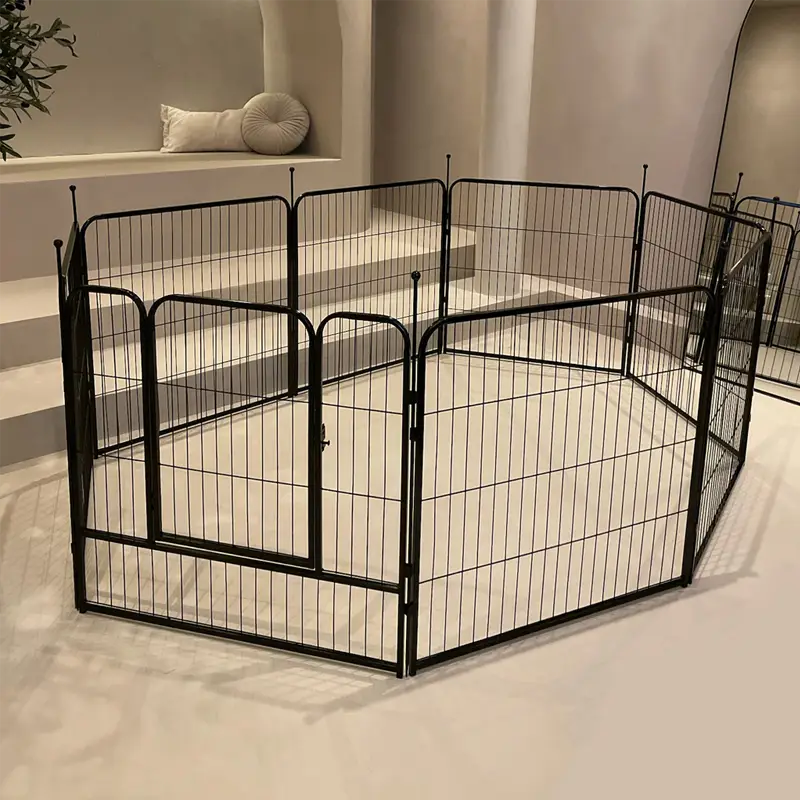
A hutch is an enclosed structure — a defined space with walls, a floor, and one or more entrances. It functions as the rabbit's safe base: the place it sleeps, eats hay, uses the litter tray, and retreats to when it feels unsure. A playpen is the opposite: an open boundary that defines a territory but doesn't enclose it. It contains the rabbit's roaming area, protects parts of your home from chewing, and keeps the rabbit out of unsafe spaces. Most well-kept indoor rabbits have both. The hutch is the base. The playpen is the territory around it. Together they make a setup that works with rabbit biology rather than against it.
How much space does a rabbit need indoors?
The often-quoted minimum is around 3 square metres of continuous floor space for a single rabbit — but that figure assumes the rabbit also gets time outside the enclosure every day. A rabbit confined to 3 square metres permanently is still a rabbit in a cage, just a slightly larger one. The version we build setups for is different: a smaller enclosed base (the hutch, around 1 square metre) combined with access to a larger surrounding territory (the playpen, or freeroam access to part of the room). The rabbit doesn't need a huge enclosed space — it needs a secure enclosure plus the ability to leave it and come back. That's what changes the dynamic from 'kept in a cage' to 'lives in your home.'
Are wooden rabbit hutches safe? Won't my rabbit chew through it?
Some rabbits do, most don't. The Freeroam Bunny Cage is built from pine and finished with a water-based, pet-safe paint — so if your rabbit does have a nibble, nothing harmful gets ingested. A determined chewer can reach parts of the interior wood, but in our experience the rabbits who actually chew their enclosure are almost always the ones who are bored, under-exercised, or kept in a space that's too small. That's exactly the problem the freeroam setup solves: the cage is the safe base, the room is the run. Rabbits with proper space, hay available at all times, and a few hours out each day overwhelmingly leave the wood alone. If you already know your rabbit is a heavy chewer, this is worth knowing upfront: pine isn't indestructible, and minor wear on reachable edges is possible over years of use. It's safe — just not chew-proof.
What about bar spacing — is it safe for my rabbit?
Bar spacing on the mansions is 45 mm, which is appropriate for adult rabbits of all standard breeds including dwarf and mini varieties. For very young rabbits (under 12 weeks) we recommend supervising the first few days to make sure your specific rabbit can't fit through — kittens at that age are sometimes unexpectedly small. The playpens use different spacing depending on the model. The full specifications are listed on each product page, but as a general rule: if your rabbit is fully grown, both the metal and plexiglass playpens are safe. If your rabbit is under six months, check the product specs before ordering.
What does 'freeroam' actually mean?
Freeroam means the rabbit isn't permanently confined to an enclosure — it has access to a larger space (a room, part of a room, or the whole home) and uses the enclosure as a safe base to return to. This works because of rabbit biology. In the wild, rabbits live in burrows and forage in the surrounding territory. They don't live exclusively underground, and they don't live exclusively in the open. They cycle between the two. Freeroam setups replicate that: a secure enclosed base (the mansion or castle) plus access to a defined surrounding territory (the playpen, or a rabbit-proofed room). The misconception is that freeroam means 'no enclosure.' It doesn't. A rabbit without a secure base is an anxious rabbit — it just has a larger area to be anxious in.