
How much hay does
your rabbit actually need?
Hay is not a supplement — it is the foundation of every healthy rabbit's diet. Use the calculator below to find out exactly how much yours needs.
Calculate your rabbit's hay needs
Select your rabbit's breed, set the weight, choose their life stage — and get an instant daily amount plus which bag size to order. Add multiple rabbits if you have more than one.
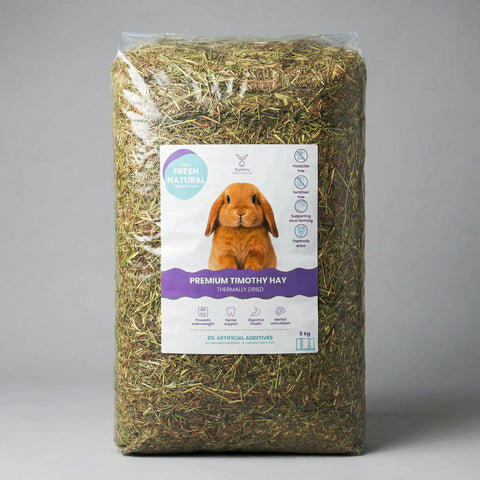
Timothy Hay
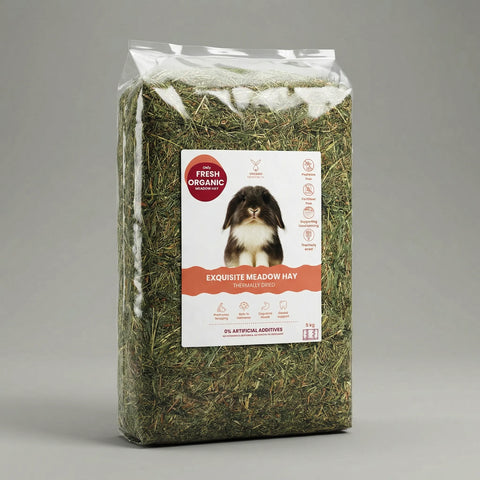
Organic Meadow Hay
Based on 100–150 g per kg of body weight per day. Hay should always be freely available — these figures are for planning and ordering, not rationing. For health concerns, consult a rabbit-savvy vet.
Why hay is not optional
Most rabbit owners know hay is important. Fewer understand why.
Rabbits have a digestive system built entirely around fibrous plant material. Their gut needs to move constantly — and the only thing that keeps it moving is long-strand fibre. That fibre comes from hay. Remove it, and the digestive tract slows, then stops. This is GI stasis, and it can kill a rabbit within 24–48 hours.
The second reason is dental. A rabbit's teeth grow continuously — roughly 2–3mm per week. Hay keeps them worn down. Without enough hay, teeth overgrow and cause infections that require surgery.
Hay should make up approximately 80% of your rabbit's total diet by volume. The remaining 20% is fresh greens, a small measured portion of pellets, and the occasional treat.
Both conditions — GI stasis and dental disease — are among the most common and most expensive rabbit health emergencies. Both are largely preventable with consistent, unlimited access to high-quality hay.
How much hay per day — by weight
The most practical rule is weight-based: a rabbit should eat between 100–150 grams of hay per kilogram of body weight per day.
| Rabbit weight | Daily minimum | Daily target | Monthly (approx.) |
|---|---|---|---|
| 0.8 kg (Dwarf) | 80 g | 100–120 g | ~3 kg |
| 1.5 kg (Small) | 150 g | 180–225 g | ~5.5 kg |
| 2.5 kg (Medium) | 250 g | 300–375 g | ~9 kg |
| 4 kg (Large) | 400 g | 480–600 g | ~14.5 kg |
| 6 kg (Giant) | 600 g | 720–900 g | ~22 kg |
If you don't want to weigh hay every day: the amount offered should be roughly the size of your rabbit's body.
Age adjustments
The 100–150 g/kg/day formula applies to adult rabbits from roughly 6 months onward. Two exceptions:
-
01
Juniors (under 6 months) Unlimited hay with no restriction. You cannot overfeed hay to a junior rabbit.
-
02
Seniors (over 5–6 years) Older rabbits may eat slightly less. A drop in hay consumption can be the first sign of dental problems.
Hay must be available 24 hours a day. It should never be rationed, given at mealtimes, or run out overnight.
Which type of hay to choose
Not all hay is nutritionally equal, and some types are genuinely unsuitable for adult rabbits.
Timothy hay
The gold standard for adult rabbits. High in fibre, low in calcium and protein.
Meadow hay
Mixed grasses and wild plants with more variety in texture and smell. Many rabbits prefer it.
Orchard grass
Softer than timothy. Lower in fibre. Good for seniors with sensitive teeth.
Alfalfa hay
High in calcium and protein. Not suitable for healthy adult rabbits long-term.
Oat hay
Higher in carbohydrates than grass hays. Fine in small quantities as a treat hay.
Soft mixed hay
Easier to chew for older or dental-compromised rabbits while still providing fibre.
Good hay smells fresh and slightly sweet — like a field, not a barn. It should be green to golden, not grey or yellow, and never dusty.
The most common hay mistakes
Most hay-related problems come from a handful of recurring errors.
-
Too many pellets Rabbits fill up on calorie-dense pellets and skip the hay. Reduce pellets and hay intake usually recovers within days.
-
Hay rack too far from the litter tray Rabbits eat while toileting. Hay positioned directly above or beside the litter tray is eaten significantly more.
-
Stale or dusty hay Rabbits ignore hay that has gone stale. Buy quantities you can use within 4–6 weeks.
-
Rationing hay to reduce waste Hay that falls on the floor is normal. Hay must be available at all times.
-
Relying on a single hay type forever Offering two varieties simultaneously keeps rabbits flexible and provides enrichment.
Storing hay correctly
Proper storage is the difference between hay that lasts months and hay that grows mould in two weeks.
-
01
Keep it dry Moisture causes mould. Store hay off the floor in a ventilated space.
-
02
Never use sealed plastic Plastic traps moisture. Use breathable containers: a wooden crate, cardboard box, or fabric laundry bag.
-
03
Out of direct sunlight UV light degrades hay and bleaches nutrients. A cool, shaded corner is ideal.
-
04
Buy in the right quantity Larger bags cost less per kilo but are only worth it if you use them before quality drops.
Hay on a schedule that fits your rabbit
Calculate your monthly amount above, then set a subscription. We send it before you run out.
Our hay range
All hay is dust-extracted, fresh-cut, and delivered in breathable packaging.
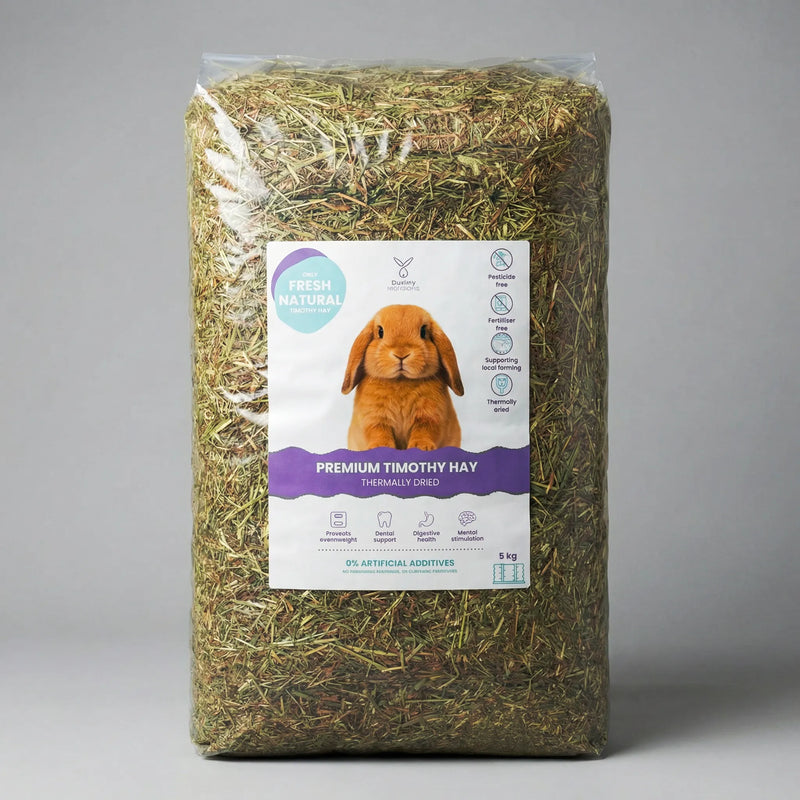
Premium Timothy Hay
First-cut, dust-extracted, high-fibre. The gold standard for adult rabbits.
Shop Timothy hay →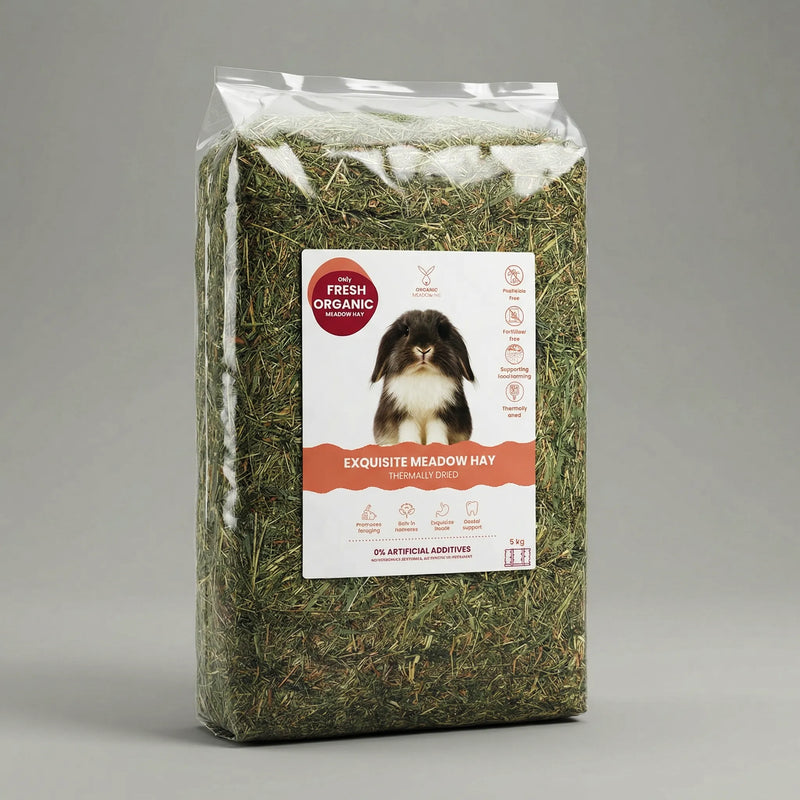
Natural Meadow Hay
Mixed wild grasses with more variety in texture and smell. Good as a main hay or alongside timothy.
Shop Meadow hay →Common questions answered
How much hay should a rabbit eat per day?
Roughly its own body size every day. Between 100–150 grams per kilogram of body weight per day.
What happens if a rabbit doesn't eat enough hay?
GI stasis and dental disease. Both are life-threatening and largely preventable.
Can a rabbit eat too much hay?
No. Unlimited hay is the correct approach for adult rabbits.
What is the best type of hay for rabbits?
Timothy hay for adults. Meadow hay is an excellent alternative. Alfalfa only for rabbits under 6 months.
Do baby rabbits need different hay?
Rabbits under 6 months can have unlimited alfalfa hay alongside timothy or meadow hay.
Why does my rabbit ignore the hay?
Most often: too many pellets. Other causes: stale hay, hard-to-access rack, or a dental problem.
How should I store hay?
Cool, dry, well-ventilated space. Never sealed plastic. Off the floor and away from sunlight.